

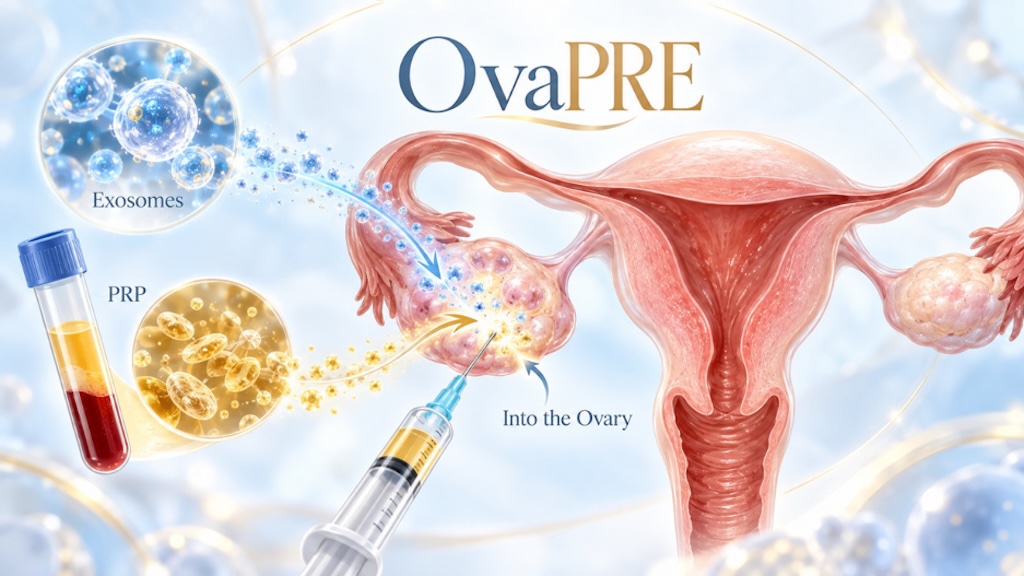
New Approaches to Ovarian Function and Fertility
For women with low AMH, diminished ovarian reserve or a previous poor response to IVF, understanding the available treatment options can be challenging.
OvaPRE (Ovarian Platelet-Rich Exosome) is an emerging ovarian treatment that uses exosomes, potentially combined with platelet-rich plasma (PRP), as part of ongoing research into ovarian function and reproductive health.
At Alhaya Fertility Centre in Kuala Lumpur, Malaysia, our fertility specialists provide individualised assessments to help patients understand investigational approaches such as OvaPRE, their potential limitations, and established fertility treatment alternatives.
OvaPRE remains experimental. Its effectiveness in improving egg quality, ovarian reserve, pregnancy rates or live birth rates has not been established.
Speak to Our Fertility Team on WhatsApp
What Is OvaPRE Ovarian Exosome Treatment?
OvaPRE stands for Ovarian Platelet-Rich Exosome. It is an investigational treatment approach involving exosomes, which may be combined with autologous platelet-rich plasma (A-PRP) and administered directly into the ovaries.
The approach is being researched for its potential effects on ovarian cell signalling and the surrounding tissue environment.
Understanding Exosomes
Exosomes are tiny membrane-bound particles released by cells. They carry biological substances, including proteins, lipids and genetic material, that play roles in communication between cells.
Researchers are investigating whether certain exosomes may influence inflammation, cellular activity and tissue responses in the ovaries.
These biological possibilities are promising areas of research, but they do not establish that exosome injections can restore fertility in humans.
Understanding Platelet-Rich Plasma (PRP)
Platelet-rich plasma is prepared from a patient’s own blood. It contains a concentration of platelets and associated growth factors.
PRP has been studied in different medical fields, including reproductive medicine. However, the clinical benefits of injecting PRP into the ovaries remain uncertain.
Combining exosomes and PRP is intended to investigate whether their biological activities could have complementary effects. A clinically meaningful synergistic benefit has not yet been established.
Why Is OvaPRE Being Studied for Ovarian Rejuvenation?
Ovarian rejuvenation is a term used to describe experimental approaches that aim to influence ovarian function.
As women age, the number of remaining eggs naturally declines. Certain medical conditions may also affect ovarian reserve or the response to fertility treatment.
Researchers are studying whether exosome-based approaches could influence:
- Ovarian cell communication and the local tissue environment
- Follicle development and ovarian responsiveness
- Biological pathways involved in ovarian ageing
- Egg maturation and response to ovarian stimulation
These are areas of scientific investigation, not guaranteed treatment benefits.
OvaPRE has not been proven to generate new eggs, reverse ovarian ageing, restore ovarian reserve or improve the likelihood of having a baby.
Who Might Discuss OvaPRE With a Fertility Specialist?
OvaPRE may be raised during specialist discussions involving certain ovarian conditions. Having one of these conditions does not automatically make a patient suitable for an experimental procedure.
1. Women With Low AMH
Anti-Müllerian hormone (AMH) is commonly used to help assess ovarian reserve.
Women with low AMH may produce fewer eggs during ovarian stimulation. However, AMH alone cannot determine whether a woman can conceive naturally or whether her eggs are of good quality.
A fertility assessment is important before considering further treatment.
2. Women With Diminished Ovarian Reserve (DOR)
Diminished ovarian reserve refers to a reduced number of remaining eggs relative to what may be expected clinically.
Assessment typically considers age, AMH, antral follicle count (AFC), medical history and previous treatment response.
Patients should first understand their established fertility treatment options before considering experimental add-ons.
3. Women With Poor Ovarian Response During IVF
Some women produce fewer follicles or retrieve fewer eggs than expected during ovarian stimulation.
This can occur for several reasons, including age, ovarian reserve and individual responses to medication.
A specialist may review previous IVF cycles, stimulation protocols and laboratory findings to determine whether an alternative treatment strategy is appropriate.
4. Women With Premature Ovarian Insufficiency (POI)
Premature ovarian insufficiency occurs when ovarian function becomes significantly reduced before the age of 40.
Some women with POI experience irregular or absent menstruation and difficulty conceiving.
OvaPRE has not been demonstrated to restore normal ovarian function or reliably achieve pregnancy in women with POI. Specialist evaluation is particularly important in this group.
5. Women Seeking a Second Opinion After IVF Failure
A previous unsuccessful IVF cycle does not necessarily indicate an ovarian reserve problem.
Embryo development, sperm factors, age, uterine conditions and other clinical factors may contribute.
At Alhaya, a detailed review can help identify possible reasons for the previous outcome and whether changes to the IVF plan may be appropriate.
Not sure what your low AMH result means?
Our fertility specialists can review your medical history, ovarian reserve investigations and previous IVF records.
Arrange a Fertility Assessment at Alhaya
How Does the OvaPRE Procedure Work?
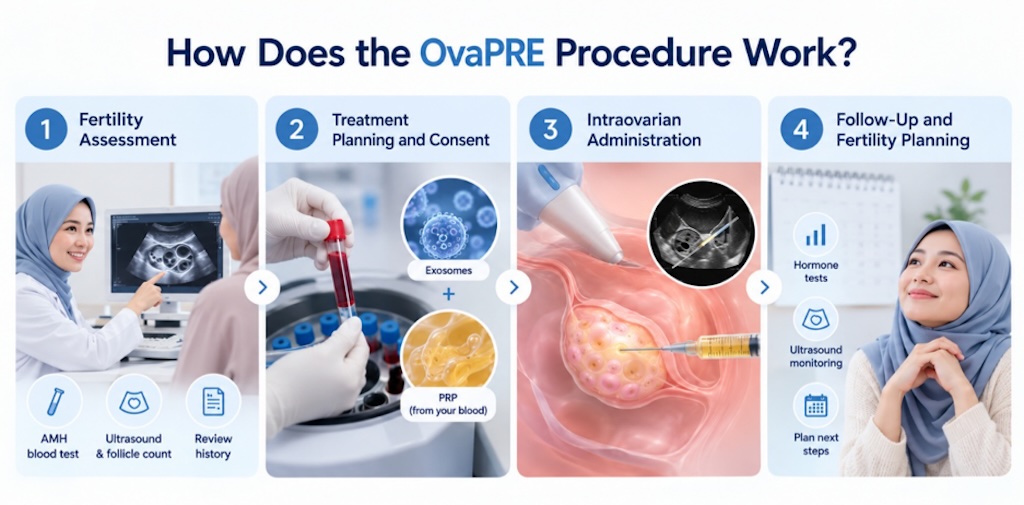
The treatment protocol, preparation, timing and follow-up requirements must be confirmed by the treating specialist. The following explains the general approach described for intraovarian exosome and PRP procedures.
Step 1 — Fertility Assessment
The process begins with a review of the patient’s reproductive and medical history.
The assessment may include:
- AMH blood test
- Transvaginal ultrasound and antral follicle count
- FSH, LH and estradiol testing when indicated
- Review of previous IVF stimulation and egg retrieval results
- Additional investigations based on individual health and safety considerations
The specialist will discuss whether established fertility treatments or any investigational approach merits further consideration.
Step 2 — Treatment Planning and Consent
Before any procedure, patients should understand the proposed exosome preparation, its source, the reasons for considering treatment, the quality and safety information available, and the limitations of clinical evidence.
Where PRP is part of the protocol, a blood sample is collected and processed to prepare the platelet-rich component.
The proposed treatment, product source, eligibility and any required approvals must be verified before proceeding.
Step 3 — Intraovarian Administration
Intraovarian treatment protocols described in fertility practice involve introducing the preparation into the ovaries under ultrasound guidance.
The approach to anaesthesia, procedure duration and immediate recovery depends on the protocol and the patient’s clinical needs.
Your specialist will explain the procedure-specific risks before consent.
Step 4 — Follow-Up and Fertility Planning
Following treatment, the fertility team may recommend monitoring through hormonal investigations, ultrasound scans or other clinically relevant assessments.
Depending on the individual case, the next steps may involve continued observation, ovarian stimulation, IVF or another fertility treatment approach.
Changes in AMH or ultrasound findings do not, by themselves, demonstrate that treatment has improved the chance of a live birth.
Can OvaPRE Improve Egg Quality or AMH Levels?
This is one of the most important questions for patients researching ovarian exosome treatment.
At present, there is insufficient high-quality clinical evidence to conclude that OvaPRE improves egg quality, AMH levels, pregnancy rates or live birth rates.
AMH is primarily a marker of ovarian reserve, not a direct measure of egg quality. A change in AMH after treatment should not be interpreted as proof that fertility has improved.
The patient’s age, ovarian response, embryo development and other fertility factors remain important when planning treatment.
What Does the Scientific Research Say?
Research on ovarian exosomes and PRP continues to develop.
Exosome studies: A 2026 systematic review of 33 animal studies reported promising findings involving ovarian reserve markers. However, animal research cannot establish whether ovarian exosome injections are effective or safe in women.
Exosome and PRP combination research: A study presented in Human Reproduction in July 2026 examined approximately 180 women receiving exosome-based ovarian interventions. The researchers reported signals relating to egg maturity and fertilisation, but the study was retrospective, lacked a randomised control group, and used varying treatment approaches. It did not establish that treatment caused better live birth outcomes.
PRP research: Clinical studies of intraovarian PRP have produced mixed results. The UK’s Human Fertilisation and Embryology Authority (HFEA) considers intraovarian PRP an add-on with insufficient reliable evidence of improvement in the chance of having a baby, alongside potential safety concerns. This assessment relates to PRP and should not be treated as a direct assessment of the complete OvaPRE combination.
More rigorous clinical trials are needed to establish which patients, if any, benefit from ovarian exosome-based treatment.
OvaPRE vs Ova-PRP vs IVF vs IVA: What Is the Difference?
These treatments have different purposes and should not be considered interchangeable.
| Treatment | What It Involves | Who Is It For? |
| OvaPRE | Investigational ovarian administration of exosomes, potentially combined with PRP | For women with low AMH, diminished ovarian reserve (DOR), or poor ovarian response during IVF |
| Ova-PRP | Injection of platelet-rich plasma prepared from the patient’s blood into the ovaries | For women with low AMH, diminished ovarian reserve, or poor ovarian response. |
| IVF / ICSI | Ovarian stimulation, egg retrieval, fertilisation in the laboratory and embryo transfer | Couples experiencing infertility due to female factors, male factors, or unexplained infertility. ICSI is particularly relevant for certain sperm-related fertilisation problems. |
| In-Vitro Activation (IVA) | Specialised processing of ovarian tissue intended to activate of remaining follicles | Highly selected women with premature ovarian insufficiency (POI) who may still have residual follicles, including some with extremely low AMH. |
A fertility specialist can help explain how these options differ and which approaches may be reasonable based on your diagnosis.
Learn More About In-Vitro Activation (IVA) at Alhaya
Read: Understanding Ova-PRP for Women With Low AMH
What Are the Risks and Limitations of OvaPRE?
OvaPRE should be understood as an investigational approach rather than a proven fertility treatment.
Important considerations include:
- Uncertain effectiveness: There is no established improvement in pregnancy or live birth rates.
- Limited long-term safety information: Potential effects on ovarian tissue, future pregnancy and offspring have not been fully evaluated.
- Procedure-related risks: Intraovarian injections may involve bleeding, infection, pain and risks related to anaesthesia.
- Exosome-related uncertainties: Product source, purity, manufacturing consistency, immune effects and other biological risks require careful evaluation.
- Variable patient response: There is no reliable way to guarantee a beneficial ovarian response.
- Financial considerations: Investigational treatment may involve additional costs without a proven improvement in reproductive outcomes.
Patients should receive clear information about the available evidence, alternatives, local regulatory requirements, costs and informed consent before deciding whether to proceed.
OvaPRE Treatment Cost in Malaysia
The cost of ovarian exosome treatment may depend on the proposed protocol, assessments, procedure requirements and follow-up care.
At Alhaya Fertility Centre, our team can explain the current treatment availability and applicable fees following specialist review.
Before making a decision, patients are encouraged to request a written explanation of what is included, any additional investigations or medications, and potential follow-up charges.
Enquire About OvaPRE Treatment and Fees
Why Consult Alhaya Fertility Centre?
Alhaya Fertility Centre is located in Damansara Specialist Hospital 2, Kuala Lumpur, and is part of Alpha IVF Group.
Our approach focuses on understanding the patient’s complete fertility condition before discussing available treatment options.
Individualised Fertility Assessment
Low AMH, poor ovarian response and unsuccessful IVF cycles can have different causes.
Our specialists assess each patient’s circumstances and explain the treatment options, uncertainties and possible next steps.
Comprehensive Fertility Services
Alhaya provides fertility assessment and assisted reproductive services including IVF, ICSI and specialised fertility procedures.
Where appropriate, patients can discuss different options within a broader, personalised fertility treatment plan.
Support for Malaysian and International Patients
For patients travelling from other countries, our team can assist with initial enquiries and appointment coordination.
The expected consultation and treatment schedule depends on the clinical assessment and recommended care.
Frequently Asked Questions About OvaPRE
1. Is OvaPRE the same as ovarian PRP?
No. Ova-PRP uses platelet-rich plasma prepared from the patient’s own blood. OvaPRE involves exosomes, which may be combined with PRP depending on the proposed protocol. The clinical benefits of either approach remain uncertain.
2. Can OvaPRE increase AMH levels?
It has not been established that OvaPRE reliably increases AMH levels in women. Changes in AMH, if observed, do not necessarily mean egg quality or the chance of pregnancy has improved.
3. Can exosome treatment improve egg quality?
Researchers are investigating whether exosomes may influence ovarian and follicular function. However, there is currently insufficient clinical evidence to confirm that ovarian exosome injections improve egg quality or lead to more live births.
4. Can OvaPRE reverse menopause or premature ovarian insufficiency?
There is no reliable evidence that OvaPRE can reverse menopause or restore normal ovarian function in women with premature ovarian insufficiency.
5. Is OvaPRE suitable after failed IVF?
Not necessarily. IVF may be unsuccessful for several reasons unrelated to ovarian reserve. A specialist should first review previous stimulation results, fertilisation, embryo development and other possible contributing factors.
6. Does OvaPRE replace IVF?
No. OvaPRE is an investigational ovarian intervention, whereas IVF is an established assisted reproductive treatment. OvaPRE should not be considered a proven alternative to IVF.
7. How soon can IVF begin after OvaPRE?
There is no universally established interval supported by high-quality clinical evidence. Any proposed treatment timeline must be determined by the specialist based on the procedure, safety assessment and individual fertility plan.
8. Are there age restrictions for OvaPRE?
There is no scientifically validated age range that establishes who will benefit from OvaPRE. Age is an important factor in fertility assessment, but eligibility for any investigational procedure requires individual medical review.
9. Is ovarian exosome treatment available in Kuala Lumpur?
Ovarian exosome-based approaches are being explored by selected fertility providers, including within Alpha IVF Group. Patients can contact Alhaya Fertility Centre in Kuala Lumpur to confirm current local availability, specialist assessment requirements and treatment information.
10. How much does OvaPRE cost at Alhaya?
Fees depend on the current treatment arrangements and proposed clinical protocol. Please contact our fertility team for up-to-date pricing and details of what is included.
Speak to a Fertility Specialist About Your Ovarian Reserve
If you have been diagnosed with low AMH, diminished ovarian reserve, premature ovarian insufficiency or poor ovarian response during IVF, a detailed fertility assessment can help you understand your options.
Our team at Alhaya Fertility Centre can review your history, explain established treatment pathways and discuss the evidence and uncertainties surrounding newer approaches.
Alhaya Fertility Centre – Where Life Begins
Medical References and Further Reading
- American Society for Reproductive Medicine — Testing and Interpreting Measures of Ovarian Reserve (2020)
- Yu et al. — Mesenchymal Stem Cell-Derived Exosomes for Ovarian Reserve: Systematic Review and Network Meta-Analysis Based on Animal Studies (2026)
- Human Reproduction — Intraovarian Exosome and PRP Combination Therapy in Diminished Ovarian Reserve (2026)
- Human Fertilisation and Embryology Authority — Platelet-Rich Plasma Treatment Add-On Assessment
Medical information is provided for education and does not replace an individual consultation. Treatment availability, eligibility and suitability depend on specialist assessment. Investigational procedures require appropriate clinical governance, regulatory review and informed consent.
Written by: Mohd Apdal Bin Mohtabar, Assistant Manager Sales & Digital Marketing
Reviewed by: Dr Haris Hamzah, Consultant O&G and Fertility Specialist
